Originally developed for the 2024 Busan Biennale, 96 degrees in the shade is a durational performance that explores impermanence, itinerancy, and the entanglement between labour and shelter. In the work, I disassemble and reassemble a mobile shoe-shine kiosk throughout the course of a working day, always operating under the partial and shifting shade cast by a post. The performance was documented and presented as a video installation.
The piece was sparked by a memory: an outdoor phone call on a hot summer afternoon. I remember sitting under the shade of palm trees as the day wore on. As the sun moved, so did we. We chased the shade to stay covered, our bodies subtly choreographing themselves in response to the sun. That moment stayed with me, not just for its intimacy, but for how it revealed the ways we adapt and move in relation to heat, time, and each other.
While visiting Busan, I noticed the small footpath kiosks used by local shoe-shiners, makeshift, mobile structures that offered only minimal protection from the relentless sun. They reminded me of similar structures I’ve encountered elsewhere, and of the many migrant workers I’ve spoken to whose labour is exposed not only to the elements but also to instability, surveillance, and erasure.
96 degrees in the shade inhabits this in-between space: between visibility and invisibility, between shelter and exposure. It asks: Who has access to rest? Who receives protection? And what forms of labour remain hidden in plain sight? The cyclical act of building and unbuilding the kiosk becomes a metaphor for the rhythms of precarious work, transient, repetitive, and often unseen. The structure itself becomes a stand-in for the strained body, continually adapting to conditions it did not choose.
The work also speaks to the heightened vulnerability of global labour forces under climate change. Rising temperatures are not abstract; they directly impact those already pushed to the margins, those whose shelter is temporary and whose protection is conditional. For me, the performance creates space for conversations about labour, survival, and what it means to chase the shade when the structures meant to protect us are always shifting.
The title is borrowed from “96 Degrees in the Shade,” the well-known 1977 reggae song and album by the Jamaican group Third World. I listened to this song religiously in high school, and it felt fitting in relation to this moving-image work.
The work is a moving-image installation: a single-channel video, colour, sound, 7 hr 53 min 49 sec, projected onto the floor as shown in the reference images below.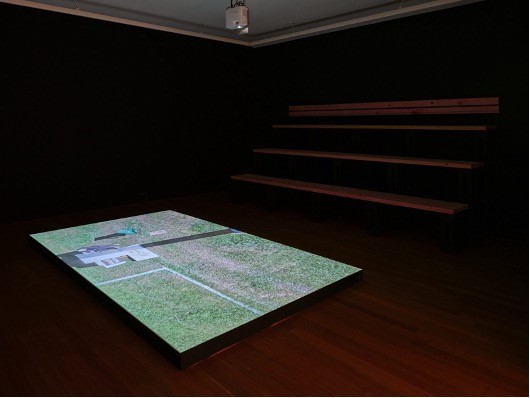
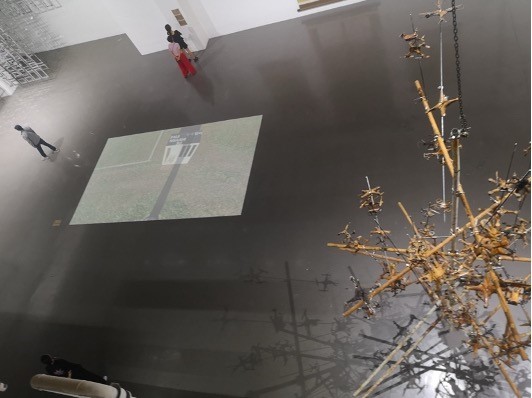
Te Tuhi Gallery, Installation, Auckland, New Zealand (2025)